

Teams searching for BrowserStack alternatives are no longer just comparing device clouds. The mobile app testing landscape has shifted toward AI-powered QA platforms that do more than execute tests. They generate test cases, adapt to UI changes, and integrate directly into development workflows.
BrowserStack remains a strong real-device testing platform. However, many teams now outgrow device-only testing due to rising maintenance costs, flaky tests, and limited intelligence. This article compares the best BrowserStack alternatives for mobile app testing in 2026, with a focus on AI-native QA platforms, enterprise device clouds, and hybrid approaches.
This guide is written for engineering leaders, QA heads, and platform teams evaluating long-term mobile testing strategy.
What Qualifies as a BrowserStack Alternative
A true BrowserStack alternative must satisfy at least one of the following:
- Provide real or virtual mobile device testing at scale
- Reduce test maintenance through AI or intelligent locators
- Generate or manage tests beyond manual scripting
- Integrate deeply into CI/CD and development workflows
Tools that only execute tests without reducing QA overhead are not considered modern alternatives.
Quick Verdict
Best BrowserStack Alternatives by Use Case
- Best AI-native mobile QA: Panto AI
- Best real-device cloud replacement: LambdaTest
- Best visual regression testing: Applitools
- Best autonomous testing platform: Mabl
- Best NLP-driven test authoring: Virtuoso QA
- Best AWS-native option: AWS Device Farm
Detailed Tool Analysis of BrowserStack Alternatives
1. Panto AI — AI-Driven Mobile QA with Deterministic Script Generation
What it does
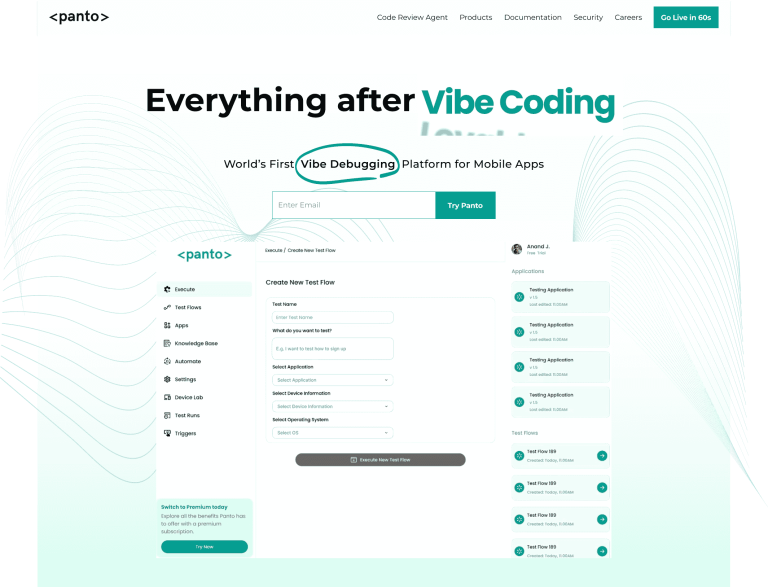
Panto AI is an AI-augmented mobile QA automation platform that transforms high-level test descriptions into deterministic, maintainable test scripts. It uses natural language understanding to interpret QA intent and generates production-ready automated flows suited for real devices and CI environments. The core engine performs actual execution on real devices, then synthesizes those runs into script artifacts that can be versioned and executed repeatedly.
Comprehensive Capabilities
- Natural Language-to-Automation Interpretation: QA engineers describe flows (e.g., “login, update profile, verify changes”) in plain text, and the system dynamically constructs executable sequences that mimic realistic user behaviour.
- Deterministic Script Output: Generated artifacts are not probabilistic AI guesses but structured, stable scripts compatible with frameworks like Appium or Maestro, ensuring repeatability and version control.
- Cross-Device Execution Integration: Tests can run across device clouds (including internal device farms, BrowserStack, or LambdaTest) without rewriting logic for each environment.
- Automatic Element Handling and Flakiness Mitigation: Intelligent recognition and adaptive waits replace brittle selectors; retries and conditional logic reduce false negatives due to transient UI changes.
- Debugging and CI/CD Integration: Test results include comprehensive traces, logs, and screenshots, enabling deep failure analysis and integration with deployment pipelines for automated quality gates.
Why it is a BrowserStack alternative
BrowserStack provides execution infrastructure, but Panto adds intelligence and automation creation capabilities above and beyond raw device access. For teams struggling with scripting overhead, flaky tests, and maintenance load, Panto’s approach can dramatically reduce operational QA cost while still leveraging underlying device clouds for execution.
Best For
Mobile QA teams with high churn in UI changes, teams lacking deep automation expertise, and organizations looking to shift from scripted automation to intent-driven test generation.
Tradeoffs
There is a learning curve to adopting NLP-centric QA workflows, and advanced customization beyond autogenerated scripts may require technical involvement. Additionally, it is optimized for application flows rather than purely device infrastructure provisioning.
2. LambdaTest — Scalable Cross-Device Testing Cloud
What it does
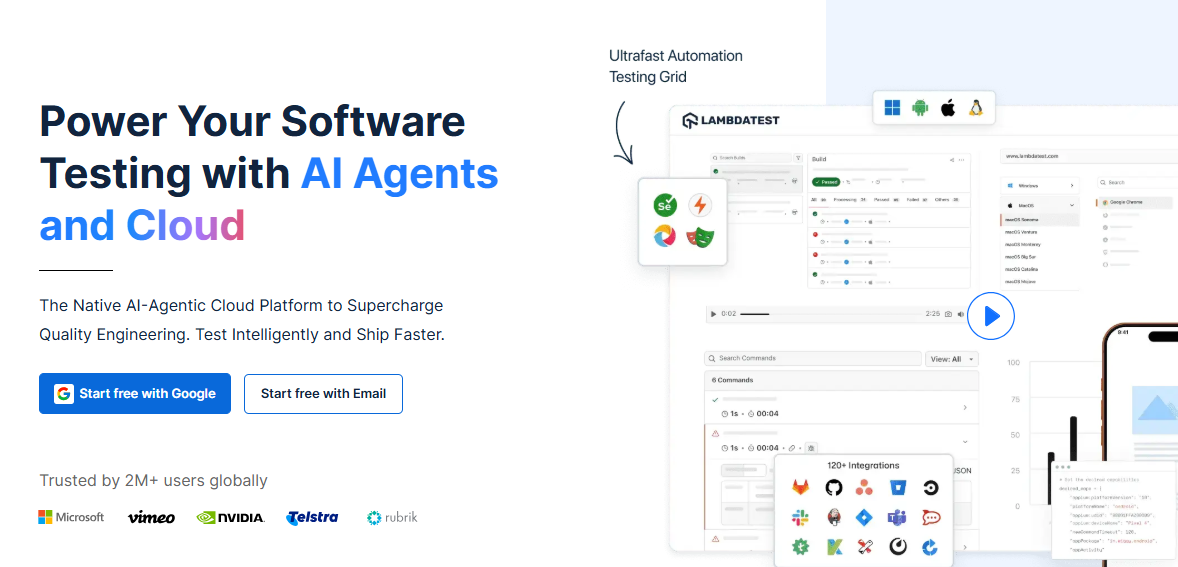
LambdaTest is a cloud testing platform offering one of the broadest arrays of real and virtual devices and browsers for cross-platform testing. It focuses on execution infrastructure, enabling testers to run manual and automated tests at high scale with CI/CD integration.
Comprehensive Capabilities
- Extensive Device and Browser Matrix: Tens of thousands of unique device and browser combinations, ensuring coverage across OS versions and screen types.
- Parallel Test Execution: High concurrency support reduces total test execution time for extensive suites.
- Native CI/CD Integrations: Executes automated suites triggered by pipelines in Jenkins, GitHub Actions, GitLab, Azure DevOps, and others.
- Debugging Support: Detailed logs, screenshots, and execution histories help isolate failures quickly during regression runs.
- Hybrid Cloud Support: Capability to combine cloud execution with on-premise device access if needed.
Why it is a BrowserStack alternative
LambdaTest matches BrowserStack’s promise of broad, cloud-scale real device coverage. It is often selected as a device cloud substitute when teams require extensive cross-browser and cross-device matrices without building an internal lab.
Best For
Organizations prioritizing maximum device/browser coverage and those with large parallel test execution needs within CI/CD pipelines.
Tradeoffs
LambdaTest does not inherently reduce the automation maintenance burden; it remains an execution layer rather than a test generation or smart automation platform.
3. Applitools — Visual AI for UI Regression and Visual Validation
What it does
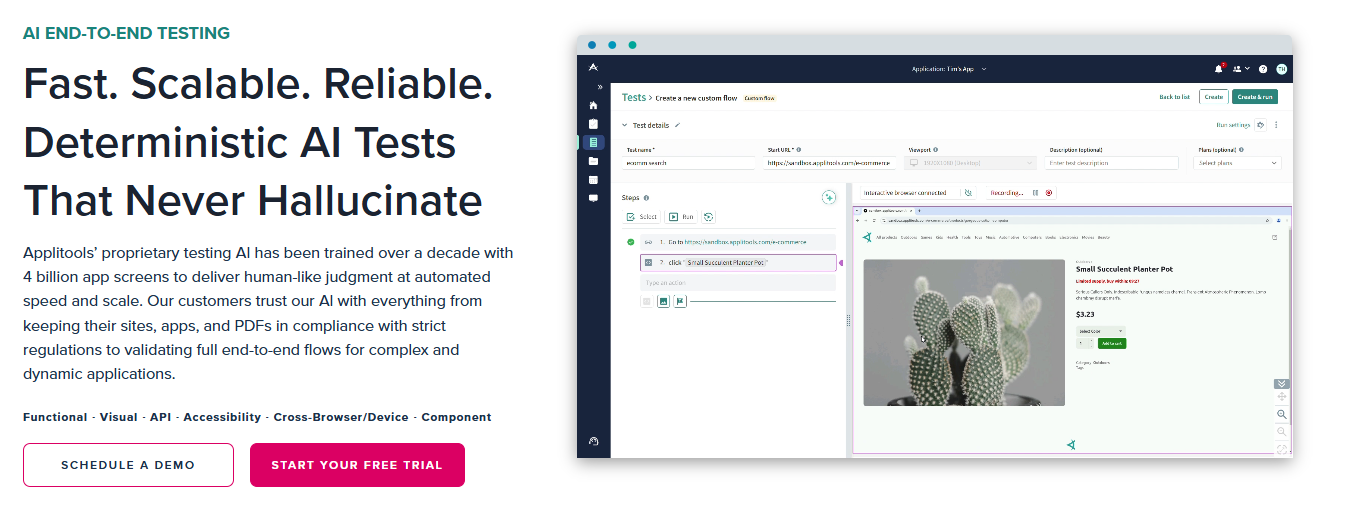
Applitools specializes in visual AI testing, providing an engine that detects unexpected visual deviations across screens, devices, and states. Its intelligent comparison goes beyond pixel-by-pixel diffs by understanding UI semantics, reducing false positives while highlighting meaningful visual regressions.
Comprehensive Capabilities
- Machine Vision-Powered Visual Validation: Examines visual output to detect layout shifts, style inconsistencies, missing elements, and regional rendering issues across viewport sizes and devices.
- Cross-Framework Support: Works with a wide range of functional automation frameworks (Selenium, Appium, Cypress, Playwright), allowing visual assertions to be embedded within existing test suites.
- Self-Healing and Root-Cause Analysis: The platform maintains baseline versions, tracks visual differences intelligently, and delivers contextual insights into why visual defects occurred.
- Accessibility and UI Compliance Checks: Advanced features help detect accessibility regressions and enforce visual standards over design systems.
Why it is a BrowserStack alternative
BrowserStack includes basic visual testing capabilities, but Applitools provides enterprise-class visual AI that catches visual UI regressions automated functional tests cannot. This makes it a stronger choice for quality assurance where UI accuracy is as important as functional correctness.
Best For
Applications with significant user experience and design requirements, where visual correctness is critical across devices and screen sizes.
Tradeoffs
Applitools is not a full functional testing framework; it enhances visual validation as part of a broader QA stack but does not replace infrastructure-level execution services.
4. Mabl — Autonomous Test Creation and Self-Healing Automation
What it does
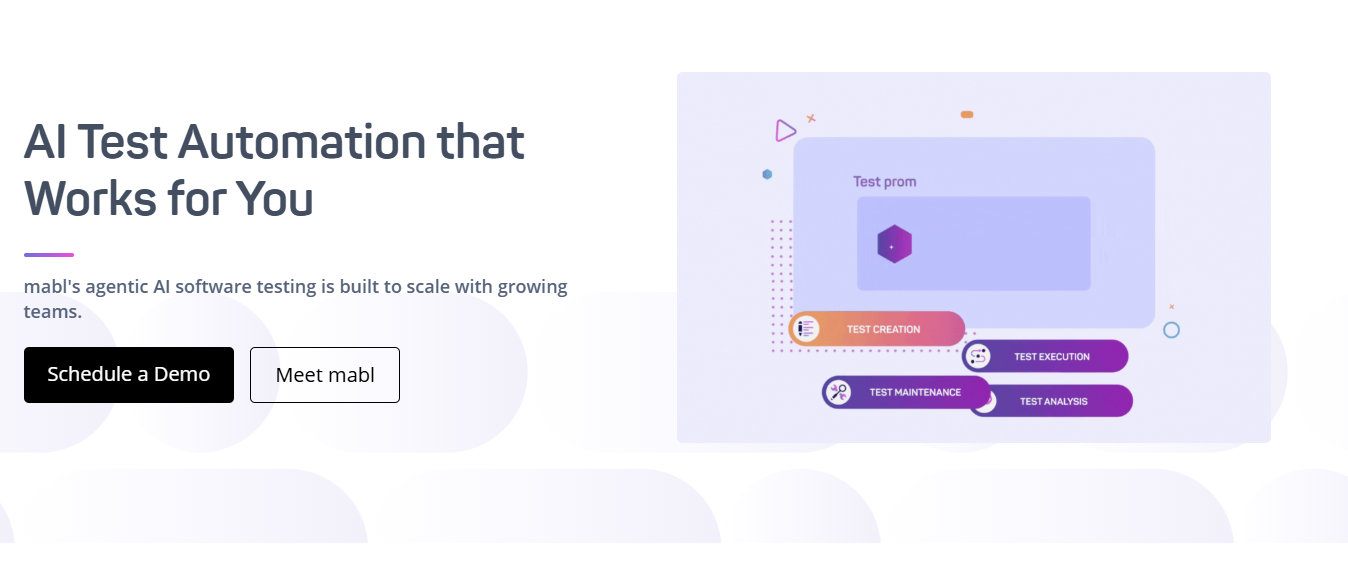
Mabl is an AI-native test automation platform that uses machine learning to autonomously create, maintain, and execute end-to-end tests for web and mobile applications. The platform treats test automation as a continuously adaptive system, minimizing manual scripting.
Comprehensive Capabilities
- Autonomous Test Generation: Mabl can derive test coverage from user stories, click-through recordings, or high-level descriptions, expanding across functional and regression paths.
- Self-Healing and Predictive Stability: Tests continuously adapt to UI changes, reducing failures caused by superficial updates and limiting maintenance overhead.
- Root-Cause Diagnostics and Analytics: Intelligent analysis surfaces likely causes of failures, integrates with tracking systems, and automates creation of actionable tickets.
- Cross-Stack Testing: Beyond UI, Mabl supports API and hybrid flows, enabling unified coverage within a single automation suite.
- Low-Code Authoring: Provides tools that let QA engineers build comprehensive suites without deep coding expertise.
Why it is a BrowserStack alternative
Rather than focusing purely on device execution, Mabl replaces the scripting layer and shifts QA toward autonomous test orchestration. It integrates execution, maintenance, and analysis in a single platform, potentially reducing reliance on separate tools like BrowserStack.
Best For
Teams aiming to significantly reduce scripted QA overhead and scale automation coverage without proportional increases in engineering effort.
Tradeoffs
Highly autonomous workflows may sacrifice some granular control, and extremely customized flows might still require manual intervention or custom logic.
5. Virtuoso QA — Natural Language Test Authoring and Enterprise-Ready Automation

What it does
Virtuoso QA is an AI-native testing platform that enables teams to author tests in natural language, which are then executed across platforms with contextual understanding and adaptive logic. It abstracts much of the complexity of test scripting and supports enterprise-grade workflows.
Comprehensive Capabilities
- Plain-Language Test Descriptions: Tests are authored in human-readable language, lowering barriers for non-technical testers and business stakeholders to contribute to automation.
- AI-Driven Element Identification: The platform combines structural DOM analysis and visual context to maintain test stability as UX elements evolve.
- Parallel Execution and Orchestration: Tests can run concurrently across environments with detailed reporting and analytics.
- Unified UI and API Coverage: Supports broad QA scopes including complex business flows spanning multiple systems.
Why it is a BrowserStack alternative
Virtuoso QA not only abstracts test creation but integrates self-maintenance and execution capabilities, enabling teams to scale QA even with limited scripting expertise. It replaces the conventional automation pipeline with a more accessible, AI-controlled workflow.
Best For
Large teams with mixed technical skills where accelerating test generation and reducing technical debt in automation are priorities.
Tradeoffs
Enterprise pricing and the abstraction layer can obscure behavior details for highly specialized test scenarios requiring deep debugging.
6. ACCELQ — Codeless, Unified Automation for Multi-Layer Testing
What it does
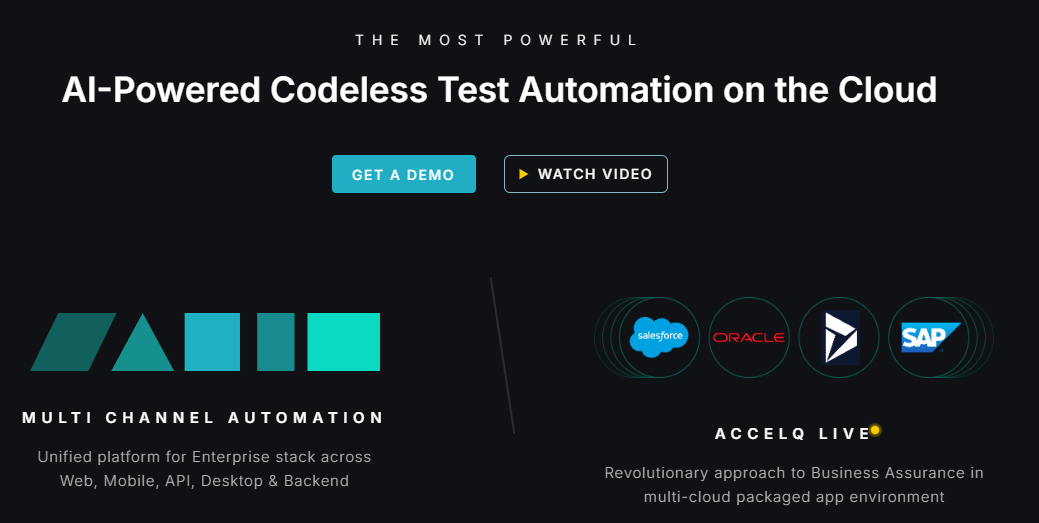
ACCELQ is a unified test automation platform that delivers codeless test construction, execution, and orchestration across web, mobile, APIs, and backend services. It emphasizes a holistic automation strategy that consolidates multiple testing needs under one platform.
Comprehensive Capabilities
- Graphical Test Design Interface: Test logic is constructed visually, enabling reusable logical assets and flows with minimal scripting.
- Cross-Layer Integration: Test covers UI, API, and backend logic within the same framework, reducing context switching and tool fragmentation.
- Parallel Execution and Analytics: Built-in execution capabilities coupled with analytics dashboards help manage large suites and diagnose failures.
Why it is a BrowserStack alternative
ACCELQ serves as a test automation consolidation layer, reducing reliance on disparate tools for different parts of the QA lifecycle. It supports device-agnostic automation by embedding execution logic within its unified approach.
Best For
Organizations seeking to consolidate automation across multiple vectors (mobile, web, API) without maintaining separate toolchains.
Tradeoffs
Not as mobile-centric or specialized in device execution as pure device clouds; may require integration with external device labs.
7. TestGrid — Scriptless Automation with Network and Device Simulation

What it does
TestGrid is a scriptless automation and mobile test platform that enables rapid creation of automated tests without deep coding experience. It pairs real device execution with network condition simulation and streamlined test orchestration.
Comprehensive Capabilities
- Scriptless Test Creation: Users create tests through intuitive builders and record/test flows without writing code.
- Real Devices with Network Simulation: Supports robust execution that mimics real-world network variances, improving the quality of mobile QA.
- Reporting and Debugging Tools: Provides logs, execution records, and analytics to help QA engineers assess outcomes and failures.
Why it is a BrowserStack alternative
TestGrid bridges the gap between infrastructure access and test creation by enabling rapid scriptless workflows coupled with real device execution. It’s positioned as a simpler alternative to traditional device cloud + automation stacks.
Best For
Teams with limited automation expertise that need to quickly validate flows and device behaviour without scripting overhead.
Tradeoffs
Lacks deep AI-driven insights and advanced test intelligence; suitability may diminish for highly complex enterprise automation.
8. Testim — AI-Enhanced Smart Locator Stabilization
What it does
Testim focuses on AI-enhanced element recognition and smart locator strategies that stabilize tests over UI changes. Its reinforcement learning-backed editor improves resilience of automation suites by detecting components using multi-attribute heuristics.
Comprehensive Capabilities
- Smart Locators and Self-Maintenance: Machine learning identifies robust selectors that persist through UI changes, reducing flaky failures.
- Hybrid Code/Codeless Environment: Test creation can mix automated suggestions with hand-authored logic for flexibility.
- CI/CD Pipeline Compatibility: Integrates with common DevOps workflows, allowing automated execution within build cycles.
Why it is a BrowserStack alternative
While Testim does not provide its own device cloud, its ability to reduce flaky tests and maintenance burden can amplify the value of execution platforms like LambdaTest or BrowserStack, making it an indirect alternative in the automation stack.
Best For
Teams struggling with unstable test suites due to dynamic UI and DOM shifts.
Tradeoffs
Testim still depends on execution infrastructure, and its automation requires integration with external device labs.
9. AWS Device Farm — AWS-Integrated Real Device Testing
What it does
AWS Device Farm offers cloud-hosted real device testing tightly integrated with the broader AWS ecosystem. It supports automated and manual tests, remotely accessible devices, and detailed logs and execution results.
Comprehensive Capabilities
- Real Device Access at Scale: Enables test execution on a broad set of Android and iOS devices.
- Parallel Test Runs: Improves throughput for large regression packs.
- Integration with AWS Toolchains: Seamless connection with AWS build and deployment pipelines, enhancing automation workflows for AWS-centric teams.
Why it is a BrowserStack alternative
It provides a cost-efficient real device execution layer within AWS workflows, reducing dependency on third-party device clouds.
Best For
Organizations already standardized on AWS infrastructure that want tight integration between QA and deployment pipelines.
Tradeoffs
AWS Device Farm does not inherently offer smart test creation or AI test intelligence; it remains an execution service.
10. Firebase Test Lab — Android-Focused Cloud Testing
What it does
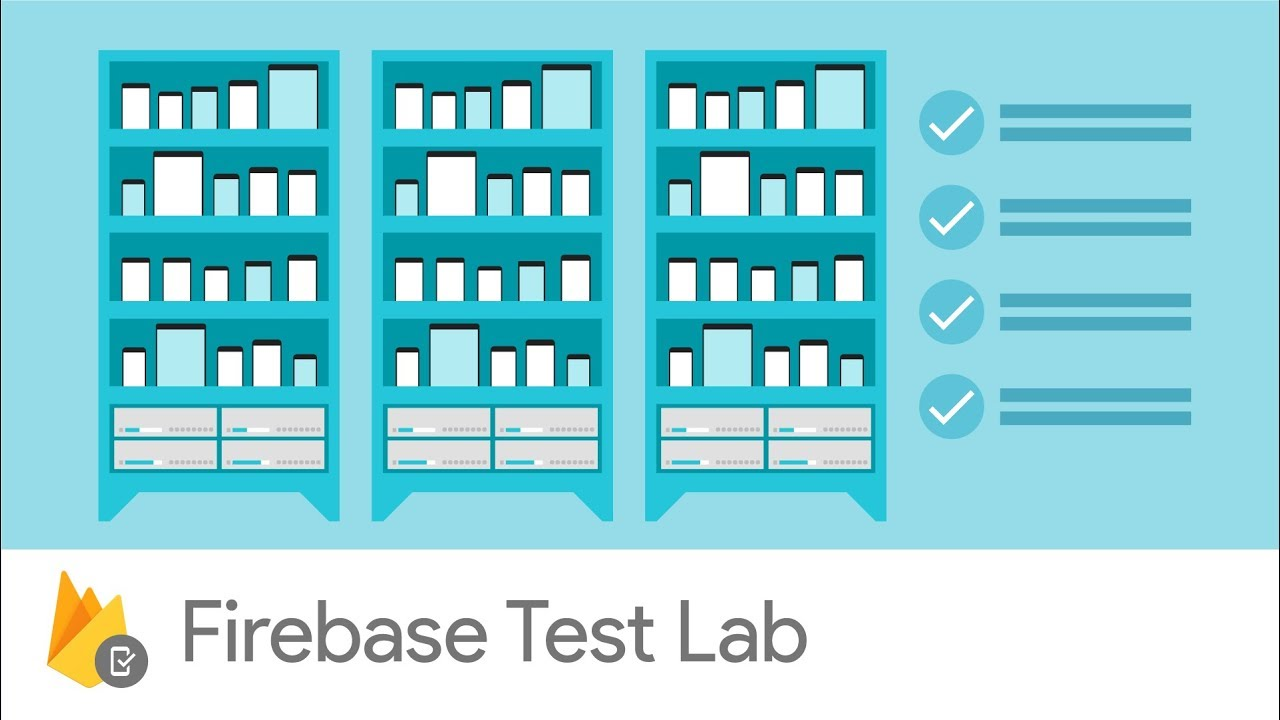
Firebase Test Lab is a Google-backed test execution environment optimized for Android (with limited iOS support). It supports automated debugging via instrumentation frameworks and proactive checks like Robo tests.
Comprehensive Capabilities
- Cloud Device Execution: Run tests against a pool of real and virtual Android devices.
- Robo and Instrumentation Automation: Automated exploration combined with scripted instrumentation tests for broad coverage.
- Detailed Execution Logs and Crash Reports: Helps diagnose failures effectively.
Why it is a BrowserStack alternative
For Android-centric teams, especially those embedded in the Firebase ecosystem, Firebase Test Lab provides a cost-effective cloud execution option with streamlined integration.
Best For
Android development teams focused on rapid iteration and testing within Google’s ecosystem.
Tradeoffs
Coverage and support for iOS are limited, and the platform does not directly address automation maintenance or test intelligence.
Technical Summary of BrowserStack Alternatives
| Tool | Core Strength | Primary Advantage | Use Case Fit |
|---|---|---|---|
| Panto AI | AI-driven automation | Natural language to deterministic scripts | Reduce maintenance, scale automation |
| LambdaTest | Device cloud | Large device/browser matrix | Cross-platform execution |
| Applitools | Visual AI | Deep visual regression detection | UI quality assurance |
| Mabl | Autonomous tests | Self-healing, agentic automation | Reduce manual scripting |
| Virtuoso QA | NLP test authoring | Accessible automation | Enterprise teams with non-technical testers |
| ACCELQ | Unified automation | Multi-layer test consolidation | Cross-stack QA needs |
| TestGrid | Scriptless automation | Rapid creation with simulation | Quick test setup |
| Testim | Smart locators | Reduce flaky tests | Stabilize automation suites |
| AWS Device Farm | AWS integration | Native AWS device execution | AWS-native CI/CD workflows |
| Firebase Test Lab | Android focus | Cost-effective Android testing | Android-centric teams |
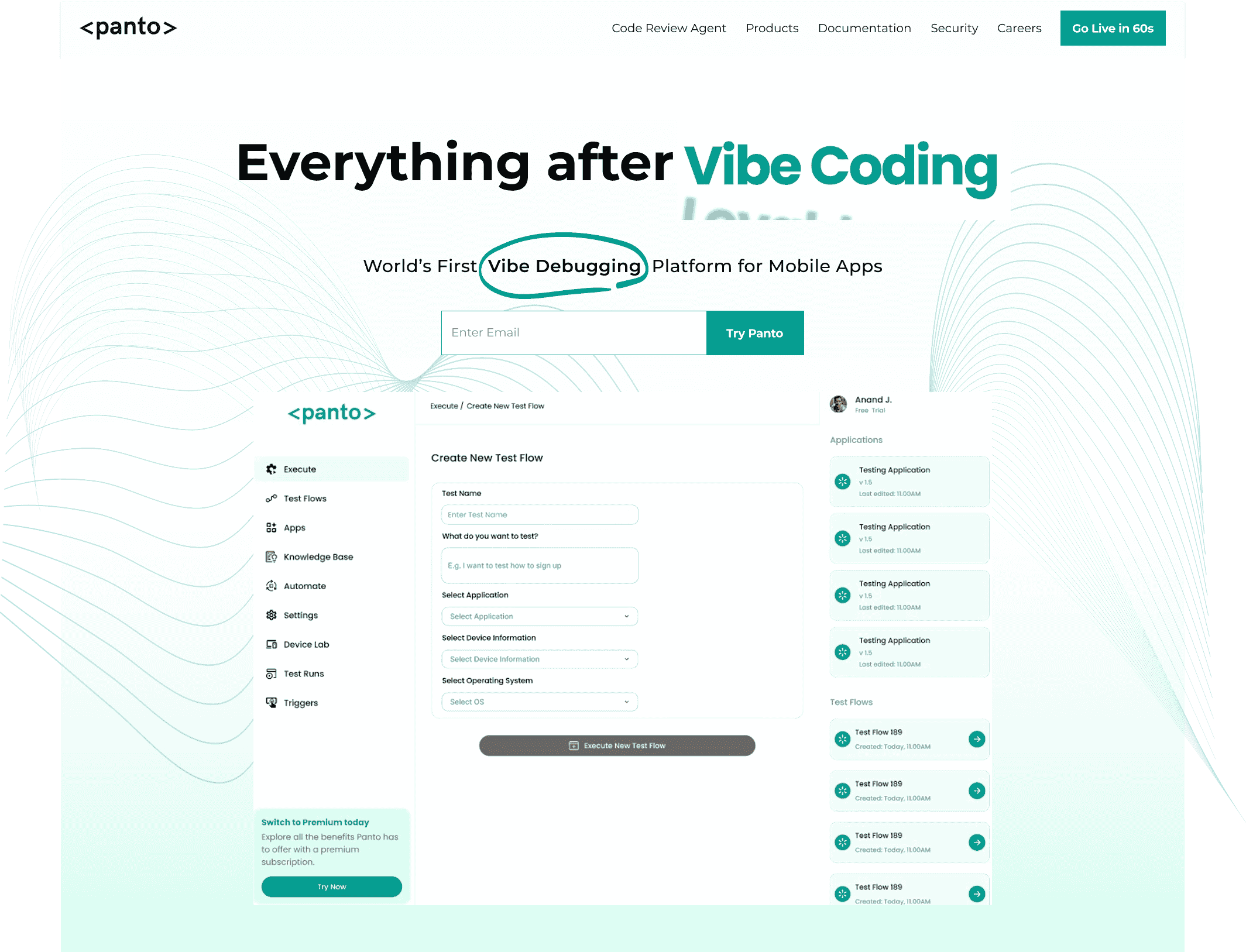
Everything After Vibe Coding
Panto AI helps developers find, explain, and fix bugs faster with AI-assisted QA—reducing downtime and preventing regressions.
- ✓ Explain bugs in natural language
- ✓ Create reproducible test scenarios in minutes
- ✓ Run scripts and track issues with zero AI hallucinations
Decision Guide
| Primary Pain Point | Recommended Tool |
| Flaky tests and high maintenance | Panto AI |
| Need massive device coverage | LambdaTest |
| Visual bugs in production | Applitools |
| Too much manual QA effort | Mabl |
| Non-technical testers | Virtuoso QA |
When BrowserStack Still Makes Sense
BrowserStack remains a strong choice when:
- You primarily need live manual testing
- Your tests are already stable
- AI-driven automation is not a priority
Final Thoughts
Choosing among BrowserStack alternatives is less about features and more about philosophy. Device clouds solve access problems. AI QA platforms solve scale and maintenance problems.
Teams investing in intelligent testing platforms tend to ship faster with fewer regressions and lower QA overhead.
For teams evaluating AI-native mobile testing, it is worth assessing whether execution alone is enough, or whether intelligence should be part of the testing stack.